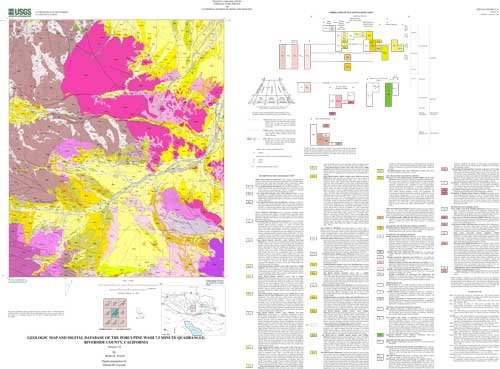
This data set maps and describes the geology of the
Porcupine Wash 7.5 minute quadrangle, Riverside County,
southern California. The quadrangle, situated in Joshua
Tree National Park in the eastern Transverse Ranges
physiographic and structural province, encompasses parts
of the Hexie Mountains, Cottonwood Mountains, northern
Eagle Mountains, and south flank of Pinto Basin. It is
underlain by a basement terrane comprising Proterozoic
metamorphic rocks, Mesozoic plutonic rocks, and Mesozoic
and Mesozoic or Cenozoic hypabyssal dikes. The basement
terrane is capped by a widespread Tertiary erosion
surface preserved in remnants in the Eagle and Cottonwood
Mountains and buried beneath Cenozoic deposits in Pinto
Basin. Locally, Miocene basalt overlies the erosion
surface. A sequence of at least three Quaternary
pediments is planed into the north piedmont of the Eagle
and Hexie Mountains, each in turn overlain by
successively younger residual and alluvial deposits.
The Tertiary erosion surface is deformed and broken by
north-northwest-trending, high-angle, dip-slip faults and
an east-west trending system of high-angle dip- and
left-slip faults. East-west trending faults are younger
than and perhaps in part coeval with faults of the
northwest-trending set.
The Porcupine Wash database was created using ARCVIEW and
ARC/INFO, which are geographical information system (GIS)
software products of Envronmental Systems Research Institute
(ESRI). The database consists of the following items: (1) a
map coverage showing faults and geologic contacts and units,
(2) a separate coverage showing dikes, (3) a coverage
showing structural data, (4) a scanned topographic base at a
scale of 1:24,000, and (5) attribute tables for geologic
units (polygons and regions), contacts (arcs), and
site-specific data (points). The database, accompanied by a
pamphlet file and this metadata file, also includes the
following graphic and text products: (1) A portable document
file (.pdf) containing a navigable graphic of the geologic
map on a 1:24,000 topographic base. The map is accompanied
by a marginal explanation consisting of a Description of Map
and Database Units (DMU), a Correlation of Map and
Database Units (CMU), and a key to point-and line-symbols.
(2) Separate .pdf files of the DMU and CMU, individually.
(3) A PostScript graphic-file containing the geologic map on
a 1:24,000 topographic base accompanied by the marginal
explanation. (4) A pamphlet that describes the database and
how to access it. Within the database, geologic contacts ,
faults, and dikes are represented as lines (arcs), geologic
units as polygons and regions, and site-specific data as
points. Polygon, arc, and point attribute tables (.pat,
.aat, and .pat, respectively) uniquely identify each
geologic datum and link it to other tables (.rel) that
provide more detailed geologic information.
Purpose:
The data set for the Porcupine Wash quadrangle has been
prepared by the Southern California Areal Mapping Project
(SCAMP), a cooperative project sponsored jointly by the
U.S. Geological Survey and the California Division of
Mines and Geology. The Porcupine Wash data set represents
part of an ongoing effort to create a regional GIS
geologic database for southern California. This regional
digital database, in turn, is being developed as a
contribution to the National Geologic Map Database of the
National Cooperative Geologic Mapping Program of the USGS.
The Porcupine Wash database has been prepared in
cooperation with the National Park Service as part of an
ongoing project to provide Joshua Tree National Park with
a geologic map base for use in managing Park resources and
developing interpretive materials.
The digital geologic map database for the Porcupine Wash
quadrangle has been created as a general-purpose data set
that is applicable to land-related investigations in the
earth and biological sciences. Along with geologic map
databases in preparation for adjoining quadrangles, the
Porcupine Wash database has been generated to further our
understanding of bedrock and surficial processes at work
in the region and to document evidence for seismotectonic
activity in the eastern Transverse Ranges. The database is
designed to serve as a base layer suitable for ecosystem
and mineral resource assessment and for building a
hydrogeologic framework for Pinto Basin.
Supplemental_Information:
Map nomenclature and symbols
Within the geologic map database, map units are identified by
standard geologic map criteria such as formation-name, age,
and lithology. The authors have attempted to adhere to the
stratigraphic nomenclature of the U.S. Geological Survey and
the North American Stratigraphic Code, but the database has
not received a formal editorial review of geologic names.
Special symbols are associated with some map units. Question
marks have been added to the unit symbol (e.g., QTs?, Prpgd?)
and unit name where unit assignment based on interpretation of
aerial photographs is uncertain. Question marks are plotted as
part of the map unit symbol for those polygons to which they
apply, but they are not shown in the CMU or DMU unless all
polygons of a given unit are queried. To locate queried
map-unit polygons in a search of database, the question mark
must be included as part of the unit symbol.
Geologic map unit labels entered in database items LABL and
PLABL contain substitute characters for conventional
stratigraphic age symbols: Proterozoic appears as 'Pr' in LABL
and as '<' in PLABL, Triassic appears as 'Tr' in LABL and as
'^' in PLABL. The substitute characters in PLABL invoke their
corresponding symbols from the GeoAge font group to generate
map unit labels with conventional stratigraphic symbols.
Time_Period_of_Content:
Time_Period_Information:
Range_of_Dates/Times:
Beginning_Date: 1973
Ending_Date: 2000
Currentness_Reference: New data
Status:
Progress: Complete
Maintenance_and_Update_Frequency: As Needed
Spatial_Domain:
Bounding_Coordinates:
West_Bounding_Coordinate: -115.87509096
East_Bounding_Coordinate: -115.74990904
North_Bounding_Coordinate: 33.87499995
South_Bounding_Coordinate: 33.7499842
Keywords:
Theme:
Theme_Keyword_Thesaurus: none
Theme_Keyword: geologic map
Theme_Keyword: geology
Theme_Keyword: surficial geology
Theme_Keyword: bedrock geology
Theme_Keyword: fault
Theme_Keyword: erosion surface
Theme_Keyword: pediment
Theme_Keyword: soil
Theme_Keyword: alluvial deposits
Theme_Keyword: dike
Theme_Keyword: batholith
Theme_Keyword: metamorphic rocks
Theme_Keyword: plutonic rocks
Theme_Keyword: hypabyssal rocks
Theme:
Theme_Keyword_Thesaurus: ISO 19115 Topic Categories
Theme_Keyword: geoscientificInformation
Place:
Place_Keyword_Thesaurus: None
Place_Keyword: southern California
Place_Keyword: Riverside County
Place_Keyword: Joshua Tree National Park
Place_Keyword: eastern Transverse Ranges
Place_Keyword: Eagle Mountains
Place_Keyword: Hexie Mountains
Place_Keyword: Cottonwood Mountains
Place_Keyword: Pinto Basin
Place_Keyword: Porcupine Wash 7.5' quadrangle
Place_Keyword: Hexie Mountains 15' quadrangle
Place_Keyword: Eagle Mountains 30 x 60' quadrangle
Stratum:
Stratum_Keyword_Thesaurus: None
Stratum_Keyword: Pinto Gneiss
Stratum_Keyword: Augen gneiss of Monument Mountain
Stratum_Keyword: Granodiorite of Pinto Basin
Stratum_Keyword: Monzogranite of Cottonwood Pass
Stratum_Keyword: Monzodiorite of Munsen Canyon
Stratum_Keyword: Quartzite of Pinto Mountain
Stratum_Keyword: Dolomite of Iron Chief mine
Stratum_Keyword: Alluvium
Place:
Place_Keyword_Thesaurus: Augmented FIPS 10-4 and FIPS 6-4, version 1.0
Place_Keyword: 06065 = Riverside
Access_Constraints: None
Use_Constraints:
Spatial Resolution. Use of this digital geologic map
should not violate the spatial resolution of the data. The
Porcupine Wash geologic map and database was developed
using digital orthophotograph quarter quadrangles (DOQQs)
as a base. DOQQs have a pixel resolution of 1 m and are
accurate to a scale of 1:12,000 (1 in = 1,000 ft). Any
enlargement beyond 1:12,000 exceeds the spatial resolution
of the geologic data and should not be used in lieu of a
more detailed site-specific geologic evaluation.
Similarly, the digital topographic base map is derived from
the U.S. Geological Survey, 1:24,000-scale Porcupoine Wash
7.5 minute quadrangle (provisional edition, 1986); any
enlargement beyond 1:24,000 exceeds the spatial resolution
of the topographic data. Plotting or viewing of the data at
scales larger than 1:12,000 on the DOQQ base, or larger
than 1:24,000 on the topographic base, will not yield
greater real detail, although it may reveal fine-scale
irregularities below the intended resolution of the
database. Where the geologic data is used in combination
with the topographic data, the resolution of the combined
output is limited by the lower resolution of the
topographic data. Where this database is used in
combination with other data of higher resolution, the
resolution of the combined output will be limited by the
lower resolution of these data.
Content. This database, identified as "Geologic map and
digital database of the Porcupine Wash 7.5 minute
quadrangle, Riverside County, California" has been
approved for release and publication by the Director of the
U.S. Geological Survey. Although this database has been
subjected to rigorous review and is substantially complete,
the USGS reserves the right to revise the data pursuant to
further analysis and review. Furthermore, it is released
on the condition that neither the USGS nor the United
States Government may be held responsible for any damages
resulting from its authorized or unauthorized use. This
database is preliminary and has not been reviewed for
conformity with U.S. Geological Survey editorial standards
or with the North American Stratigraphic Code. Any use of
trade, product, or firm names is for descriptive purposes
only and does not imply endorsement by the U.S. Government.
Faults. The Porcupine Wash database is sufficiently
detailed to identify and characterize many actual and
potential geologic hazards represented by faults, but it is
not sufficiently detailed for site-specific determinations
or evaluations of these features. Faults shown do not take
the place of fault-rupture hazard zones designated by the
California State Geologist (see, for example, Hart, 1988;
Hart and Bryant, 1997).
Hart, E. W., 1988, Fault-rupture zones in California;
Alquist-Priolo Special Studies Zones Act of 1972 with index
to special studies zones maps (revised, 1988): California
Division of Mines and Geology Special Publication 42.
Hart, E. W., and Bryant, W.A., 1997, Fault-rupture zones in
California; Alquist-Priolo Special Studies Zones Act of
1972 with index to special studies zones maps (revised,
1997): California Division of Mines and Geology Special
Publication 42.
Point_of_Contact:
Contact_Information:
Contact_Person_Primary:
Contact_Person: Robert E. Powell
Contact_Organization:
U.S.Geological Survey, Western Region, Earth Surface
Processes Team
Contact_Position: Project geologist
Contact_Address:
Address_Type: mailing address
Address:
U.S. Geological Survey
Room 202
West 904 Riverside Avenue
Non-navigable .gif image of the geologic map, topographic
base, Correlation of Map and Database Units, Description of
Map and Database Units and key to point and line symbols. 64 kilobytes.
Navigable portable document file (.pdf) image of the geologic map,
topographic base, Correlation of Map and Database Units, Description of
Map and Database Units and key to point and line symbols. 5.4 megabytes.
Browse_Graphic_File_Type: PDF
Data_Set_Credit:
Geologic mapping, topical studies, and digital preparation
for this report were sponsored jointly by the following:
(1) the National Cooperative Geologic Mapping Program of
the U.S. Geological Survey, (2) California Division of
Mines and Geology, and (3) the National Park Service
(Joshua Tree National Park).
This database was prepared in the GIS laboratory at the
Spokane Field Office of the USGS in Spokane, Washington.
The facility is maintained primarily by the Mineral
Resource Surveys Program and supported in part by the
National Geologic Mapping Program. We thank Paul C.
Hyndman and Steven R. Munts in Spokane and Rachel Hauser
Alvarez of the SCAMP GIS laboratory at the University of
California, Riverside for their assistance in solving
problems encountered during digital preparation of the
data set.
Technical review by Jonathan C. Matti has led to
significant improvements in the database and in the map
plot file. Todd T. Fitzgibbon has examined the digital
database file for internal logical consistency, has
reviewed the metadata file, and has tested the viability
of digital products.
Native_Data_Set_Environment:
SunOS, 5.6, sun4u UNIX
ARC/INFO version 7.2.1
Cross_Reference:
Citation_Information:
Originator: Robert E. Powell
Publication_Date: 2001
Title:
Geologic map and digital database of the Conejo Well 7.5
minute quadrangle, Riverside County, California
Geospatial_Data_Presentation_Form: map
Series_Information:
Series_Name: U.S. Geological Survey Open-File Report
This initial version of the Porcupine Wash geologic map
database relies extensively on interpretation of aerial
photographs; field study of bedrock units was conducted in
the context of smaller-scale regional mapping and field
study of surficial deposits has been minimal. The map
represents the state of knowledge for the quadrangle and
provides a basis for gathering additional field data to
resolve questions raised in making the map. Attributes
assigned to regions, polygons, lines, and points in the
Porcupine Wash database are reasonably accurate as
determined by the normal range of checks and balances
applied in making a geologic map by a combination of
hands-on and remote field observation, sampling, and
interpretation of aerial photographs. Additional field
investigation, however, is required to verify the accuracy
of polygon (map unit) attributes and to establish
relations among units. Where anomalous descriptive
characteristics lead to particular uncertainty of unit
assignment of a polygon, a question mark (?) is appended
to the unit label. In the Porcupine Wash quadrangle, this
device has been used chiefly for unit assignments of
unvisited polygons that appear anomalous on aerial
photographs.
Logical_Consistency_Report:
Polygon and chain-node topology present.
The areal extent of the map is represented digitally by an
appropriately projected (Polyconic projection),
mathematically generated box. Consequently, polygons
intersecting the lines that comprise the map boundary are
closed by that boundary. Polygons internal to the map
boundary are completely enclosed by line segments which
are themselves a set of sequentially numbered coordinate
pairs. Point data are represented by coordinate pairs.
Completeness_Report:
The geologic map and digital database of the Porcupine
Wash 7.5 minute quadrangle contain new data that have been
subjected to rigorous review and are a substantially
complete representation of the current state of knowledge
concerning the geology of the quadrangle.
Positional_Accuracy:
Horizontal_Positional_Accuracy:
Horizontal_Positional_Accuracy_Report:
Geologic lines and points on 1:24,000 scale geologic maps
are judged to meet map-accuracy standards if they are
located to within +/-15 meters, relative to topographic or
cultural features on the base map. Lines and points that
meet (or may not meet) this map-accuracy standard are
identified both in the digital database and on derivative
geologic-map plots. On geologic-map plots, line data that
are judged to meet the map-accuracy standard are denoted
by solid lines; line data that may not meet the
map-accuracy standard are denoted by dashed or dotted
lines.
Contacts between lithologic domains that make up
surficial deposits as mapped on the digital
orthophotograph quarter quadrangles typically are readily
located to within 15 meters, but to make domains that can
be resolved at 1:24,000 contacts are often drawn by
approximating the dominant unit on a percentage basis.
Interspersal of well- and approximately located contacts
is common among the many hundreds of contact segments
present in the Porcupine Wash quadrangle. Given that many
quadrangles are being mapped in a relatively short time
interval, it was deemed too time-consuming to distinguish
well-located and approximately located contacts between
surficial deposits; therefore, all surficial contacts are
represented as approximately located and shown with a
dashed line symbol.
Lineage:
Process_Step:
Process_Description:
Geologic mapping for Ph.D. dissertation, supported in part
by U.S. Geological Survey (Powell, 1981). Bedrock units
and faults mapped in field on 1:36,000 true-color aerial
photographs (USGS, 1973), compiled onto a 1:62,500
topographic base map of the Hexie Mountains 15' quadrangle
(1963, paper copy), then reduced onto a 125,000
topographic base (base-stable mylar greenline). Bedrock
units in the Hexie Mountains quadrangle were mapped,
described, and interpreted by conducting field traverses
and interpolating between the traverses by interpretation
of aerial photographs. This mapping was part of a regional
study of the geology and structure of the eastern
Transverse Ranges province south of the Pinto Mountain
fault. The southeast quarter of the Hexie Mountains
quadrangle topographic map has subsequently been published
as the Porcupine Wash 7.5' quadrangle (provisional
edition, 1986).
Powell, R.E., 1981, Geology of the crystalline basement
complex, eastern Transverse Ranges, southern California:
Constraints on regional tectonic interpretation [Ph.D.
thesis]: Pasadena, California Institute of Technology, 441
p.
USGS, 1973, True color aerial photographs labeled GS-SE.
Photographs taken along northwest-southeast oriented
flight lines covering the eastern Transverse Ranges south
of the Pinto Mountain fault. Lines flown at moderate to
low sun-angle in October 1973; scale 1:36,000.
Process_Date: 1973 to 1981
Process_Step:
Process_Description:
Additional observations were made in bedrock units of the
Hexie Mountains quadrangle during the course of ongoing
geologic studies in the eastern Transverse Ranges province
(Powell, 1993).
Powell, R.E., 1993, Balanced palinspastic reconstruction
of pre-late Cenozoic paleogeology, southern California:
Geologic and kinematic constraints on evolution of the San
Andreas fault system, in Powell, R.E., Weldon, R.J., II,
and Matti, J.C., eds., The San Andreas fault system:
Displacement, palinspastic reconstruction, and geologic
evolution: Geological Society of America Memoir 178, p.
1-106.
Process_Date: 1982 to 1995
Process_Step:
Process_Description:
The geologic map and database for the Porcupine Wash
quadrangle was generated by combining the bedrock mapping
of previous process-steps with new, larger-scale mapping
both of bedrock units and surficial deposits. The new
mapping is based chiefly on interpretation of 1:24,000
color photographs (USGS, 1998), 1:40,000 NAPP infrared
color photographs (USGS, 1996), and 1:80,000 NHAP infrared
color photographs (USGS, 1983-1984) with minimal new
fieldwork at this stage. Using ARCVIEW and its Image
Analysis extension, geologic contacts, faults, and dikes
were mapped on georeferenced USGS digital orthophotograph
quarter quadrangles (DOQQs). The lines generated in
ARCVIEW were assigned basic attributes and exported to
ARCINFO where a line-polygon coverage was generated for
the geology layer. This coverage was exported back to
ARCVIEW as line and polygon shape files. Polygons were
assigned their basic attributes in ARCVIEW and re-exported
to ARCINFO for more complete attribution in the full
coverage. Polygons in the coverage are attributed to
generate the plot-file map. These plot-file map units, as
well as other mapped units and aggregates of units that
are included in the database but not shown on the
plot-file map, are further attributed as region features
(groups of polygons).
USGS, 1998, True color aerial photographs labeled J.T.N.P.
Photographs taken along east-west oriented flight lines
covering part of Joshua Tree National Park in Pinto Basin
and parts of the Coxcomb, Pinto, Eagle, Cottonwood, Hexie,
and Little San Bernardino Mountains. Lines flown at high
sun-angle in May 1998; scale 1:24,000.
Process_Date: 1997-2000
Process_Step:
Process_Description:
The source of the base hypsography, hydrography, and culture
for the geologic map is the U.S. Geological Survey,
1:24,000-scale topographic map of the Porcupine Wash 7.5
minute quadangle (provisional edition, 1986). The
topographic map was photographically reproduced on
scale-stable clear film. The resulting blackline
photo-positive image was scanned at 500 dpi using an Anatech
Eagle 4080 monochrome 800 dpi rasterizing scanner. The
raster scan was imported into ARC/INFO, registered and
rectified to the Porcupine Wash quadrangle, and saved in
GEOTIFF format. Topographic elements on the base map are
geospatially located by this process, but no features are
attributed. The topographic base map is provided for
locational reference only.
Process_Date: 2000
Process_Step:
Process_Description:
To provide a topographic base for the geologic map, the
monochromatic raster scan file and the geologic map coverages
were converted to ARC/INFO grids, merged, resulting in the
topographic and cultural information drawn in gray and the
geologic map unit colors drawn with their respective colors.
The combined map is a digital image in which geologic and
topographic lines and points are displayed in their proper
geospatial locations, but for which no information other than
location is attached to the lines and points.
Process_Date: 2000
Process_Step:
Process_Description:
Structural measurements of foliation and fold axes
orientation taken from unpublished geologic map of the
Hexie Mountains 15' quadrangle by R. A. Hope (U.S.
Geological Survey, 1964-1969).
Process_Date: 2000
Process_Step:
Process_Description:
First draft of metadata created by Pamela M.Cossette
using FGDCMETA.AML ver. 1.2 05/14/98 on ARC/INFO data set
/pool1/cossette/1_joshua/1_porc/pw_1219
Process_Date: 20001219
Spatial_Data_Organization_Information:
Direct_Spatial_Reference_Method: Vector
Point_and_Vector_Object_Information:
SDTS_Terms_Description:
SDTS_Point_and_Vector_Object_Type: Point
Point_and_Vector_Object_Count: 2587
SDTS_Terms_Description:
SDTS_Point_and_Vector_Object_Type: String
Point_and_Vector_Object_Count: 6166
SDTS_Terms_Description:
SDTS_Point_and_Vector_Object_Type: GT-polygon composed of chains
Horizontal_Datum_Name: North American Datum of 1927
Ellipsoid_Name: Clarke 1866
Semi-major_Axis: 6378206.4
Denominator_of_Flattening_Ratio: 294.98
Entity_and_Attribute_Information:
Overview_Description:
Entity_and_Attribute_Overview:
The Geologic Map and Digital Database of the Porcupine Wash
7.5 minute quadrangle includes five geospatial datasets as
ARC/INFO coverages: pwash_geo (geology), pwash_dk (dikes),
pwash_str (structural point data), pwash_orn (structural
line ornamentation), and pwash_ldr (annotation leaders).
Geospatial entities in ARC/INFO coverages have the
following software-defined attributes: <cover>.pat contains
AREA, PERIMETER, cover#, and cover-ID; <cover>.aat contains
FNODE#, TNODE#, LPOLY#, RPOLY#, LENGTH, cover#, and
cover-ID. User-defined attributes are described in detail
below and in the Porcupine Wash Open-File Report from which
this metadata is derived.
(1) The coverage pwash_geo includes the following feature
attribute tables: (a) a polygon feature attribute table
(pwash_geo.pat) that describes the geospatial distribution
of rock units represented in the Postscript (.ps) and
Portable Document Format (.pdf) plotfiles of the geologic
maps; (b)region subclass attribute tables
(pwash_geo.patmetunits, pwash_geo.patpedunits,
pwash_geo.patplutunits, pwash_geo.patsedunits,
pwash_geo.patveinunits, pwash_geo.patvolcunits) that
describe all geologic units contained in the database; and
(c) an arc feature attribute table (pwash_geo.aat) that
describes the contacts and faults that bound rock-unit
polygons. For display purposes in the .ps and .pdf
geologic maps, the geology coverage includes two annotation
subclasses: anno.geo, which contains unit labels derived
from the coded item PLABL, and anno.fault, which contains
formal fault names.
(2) The coverage pwash_dk includes an arc attribute table
(pwash_dk.aat) that describes hypabyssal dikes. Dikes are
planar intrusive features that intersect the Earth's
surface as linear features; they are represented as lines
where their surface widths are too narrow to be represented
as polygons at a scale of 1:24,000.
(3) The coverage pwash_str includes a point attribute table
(pwash_str.pat) that describes geologic structural point
data, including the types and orientation of bedding,
foliation, and lineation. An annotation subclass
(anno.value) displays the dip or plunge values associated
with point data.
(4) The coverage pwash_orn includes a point attribute table
(pw_ptsorn.pat) that describes structural line
ornamentation. An annotation subclass (anno.line) displays
the sense of movement on a fault.
(5) The coverage pwash_ldr includes an arc attribute table
(pwash_ldr.pat) that describes annotation leaders. Unit
symbols that are placed outside the perimeter of a
particular polygon identify that polygon with annotation
leaders.
Entity_and_Attribute_Detail_Citation:
<http://geopubs.wr.usgs.gov/open-file/of01--30/pwash_pamph.pdf>
A complete description of the polygon, line, and point data
coding schemes is available in U.S. Geological Survey
Open-File Reports 97-859, OFR 97-860, and OFR 97-861 (full
source citations follow):
Matti, J.C., Miller, F.K., Powell, R.E., Kennedy, S.A.,
Bunyapanasarn, T.P., Koukladas, Catherine, Hauser, R.M., and
Cossette, P.M., 1997b, Geologic-point attributes for digital
geologic-map databases produced by the Southern California
Areal Mapping Project (SCAMP), Version 1.0: U.S.Geological
Survey Open-File Report 97-859
Matti, J.C., Miller, F.K., Powell, R.E., Kennedy, S.A., and
Cossette, P.M., 1997c, Geologic-polygon attributes for
digital geologic-map databases produced by the Southern
California Areal Mapping Project (SCAMP), Version 1.0:
U.S.Geological Survey Open-File Report 97-860
Matti, J.C., Powell, R.E., Miller, F.K., Kennedy, S.A.,
Ruppert, K.R., Morton, G.L., and Cossette, P.M., 1997a,
Geologic-line attributes for digital geologic-map databases
produced by the Southern California Areal Mapping Project
(SCAMP), Version 1.0: U.S.Geological Survey Open-File Report
97-861
Detailed_Description:
Entity_Type:
Entity_Type_Label: pwash_geo.pat
Entity_Type_Definition:
Geologic units shown on geologic map in Postscript (.ps) and
Portable Document Format (.pdf) files
Attribute:
Attribute_Label: LABL
Attribute_Definition:
Geologic map unit label. Plain text is substituted for
conventional geologic age symbols (Pr for Proterozoic; Tr for
Triassic) and unit label subscripts as shown on map
Attribute_Domain_Values:
Enumerated_Domain:
Enumerated_Domain_Value: Qa
Enumerated_Domain_Value_Definition: Very young alluvial deposits (late Holocene)
Attribute_Domain_Values:
Enumerated_Domain:
Enumerated_Domain_Value: Qa2
Enumerated_Domain_Value_Definition: Very young alluvial deposits, Unit 2 (late Holocene)
Attribute_Domain_Values:
Enumerated_Domain:
Enumerated_Domain_Value: Qa1
Enumerated_Domain_Value_Definition: Very young alluvial deposits, Unit 1 (late Holocene)
Attribute_Domain_Values:
Enumerated_Domain:
Enumerated_Domain_Value: Qyai3
Enumerated_Domain_Value_Definition:
Young alluvial deposits, insensitive source, Unit 3 (late and
(or) middle Holocene)
Attribute_Domain_Values:
Enumerated_Domain:
Enumerated_Domain_Value: Qyai2
Enumerated_Domain_Value_Definition:
Young alluvial deposits, insensitive source, Unit 2 (middle
Holocene)
Attribute_Domain_Values:
Enumerated_Domain:
Enumerated_Domain_Value: Qyai1
Enumerated_Domain_Value_Definition:
Young alluvial deposits, insensitive source, Unit 1 (middle
and (or) early Holocene and (or) latest Pleistocene?)
Attribute_Domain_Values:
Enumerated_Domain:
Enumerated_Domain_Value: Qyas2,3
Enumerated_Domain_Value_Definition:
Young alluvial deposits, sensitive source, Units 2 and 3
(late and (or) middle Holocene)
Attribute_Domain_Values:
Enumerated_Domain:
Enumerated_Domain_Value: Qyas3
Enumerated_Domain_Value_Definition:
Young alluvial deposits, sensitive source, Unit 3 (late and
(or) middle Holocene)
Attribute_Domain_Values:
Enumerated_Domain:
Enumerated_Domain_Value: Qyas2
Enumerated_Domain_Value_Definition:
Young alluvial deposits, sensitive source, Unit 2 (late and
(or) middle Holocene)
Attribute_Domain_Values:
Enumerated_Domain:
Enumerated_Domain_Value: Qyas2?
Enumerated_Domain_Value_Definition:
Young alluvial deposits, sensitive source, Unit 2? (late and
(or) middle Holocene)
Attribute_Domain_Values:
Enumerated_Domain:
Enumerated_Domain_Value: Qyaos
Enumerated_Domain_Value_Definition:
Young alluvial deposits, oxidized, sensitive source (Holocene
and latest Pleistocene?)
Attribute_Domain_Values:
Enumerated_Domain:
Enumerated_Domain_Value: Qoai3
Enumerated_Domain_Value_Definition:
Old alluvial deposits, insensitive source, Unit 3 (late
Pleistocene)
Attribute_Domain_Values:
Enumerated_Domain:
Enumerated_Domain_Value: Qoai2
Enumerated_Domain_Value_Definition:
Old alluvial deposits, insensitive source, Unit 2 (middle?
Pleistocene)
Attribute_Domain_Values:
Enumerated_Domain:
Enumerated_Domain_Value: Qoaps
Enumerated_Domain_Value_Definition:
Old alluvial deposits, pavemented, sensitive source (late
Pleistocene)
Attribute_Domain_Values:
Enumerated_Domain:
Enumerated_Domain_Value: Qoaos
Enumerated_Domain_Value_Definition:
Old alluvial deposits, oxidized, sensitive source (middle?
Pleistocene)
Attribute_Domain_Values:
Enumerated_Domain:
Enumerated_Domain_Value: Qoaos?
Enumerated_Domain_Value_Definition:
Old alluvial deposits, oxidized, sensitive source? (middle?
Pleistocene)
Attribute_Domain_Values:
Enumerated_Domain:
Enumerated_Domain_Value: Qoars
Enumerated_Domain_Value_Definition:
Old alluvial and (or) regolithic deposits, sensitive source
(middle? Pleistocene)
Attribute_Domain_Values:
Enumerated_Domain:
Enumerated_Domain_Value: Qoc
Enumerated_Domain_Value_Definition: Old colluvial deposits (Pleistocene)
Attribute_Domain_Values:
Enumerated_Domain:
Enumerated_Domain_Value: Qoc1,2
Enumerated_Domain_Value_Definition: Old colluvial deposits, Units 1 and 2 (Pleistocene)
Attribute_Domain_Values:
Enumerated_Domain:
Enumerated_Domain_Value: Qovork
Enumerated_Domain_Value_Definition:
Old and (or) very old regolithic deposits, cemented
(middle? and (or) early? Pleistocene)
Attribute_Domain_Values:
Enumerated_Domain:
Enumerated_Domain_Value: Qvoa
Enumerated_Domain_Value_Definition: Very old alluvial deposits (middle and early Pleistocene)
Attribute_Domain_Values:
Enumerated_Domain:
Enumerated_Domain_Value: QTs?
Enumerated_Domain_Value_Definition: Sedimentary deposits? (Quaternary and (or) Tertiary)
Attribute_Domain_Values:
Enumerated_Domain:
Enumerated_Domain_Value: QTrcp
Enumerated_Domain_Value_Definition:
Regolith, monzogranite of Cottonwood Pass (Quaternary and
Tertiary)
Attribute_Domain_Values:
Enumerated_Domain:
Enumerated_Domain_Value: QTrcp?
Enumerated_Domain_Value_Definition:
Regolith, monzogranite of Cottonwood Pass? (Quaternary and
Tertiary)
Attribute_Domain_Values:
Enumerated_Domain:
Enumerated_Domain_Value: QTrpb
Enumerated_Domain_Value_Definition:
Regolith, granodiorite of Pinto Basin (Quaternary and
Tertiary)
Attribute_Domain_Values:
Enumerated_Domain:
Enumerated_Domain_Value: QTrpb?
Enumerated_Domain_Value_Definition:
Regolith, granodiorite of Pinto Basin? (Quaternary and
Tertiary)
Attribute_Domain_Values:
Enumerated_Domain:
Enumerated_Domain_Value: QTrp
Enumerated_Domain_Value_Definition: Regolith, Pinto Gneiss (Quaternary and Tertiary)
Attribute_Domain_Values:
Enumerated_Domain:
Enumerated_Domain_Value: Trscp
Enumerated_Domain_Value_Definition: Saprolite, monzogranite of Cottonwood Pass (Tertiary)
Attribute_Domain_Values:
Enumerated_Domain:
Enumerated_Domain_Value: Trscp?
Enumerated_Domain_Value_Definition: Saprolite, monzogranite of Cottonwood Pass? (Tertiary)
Attribute_Domain_Values:
Enumerated_Domain:
Enumerated_Domain_Value: KJmgccp
Enumerated_Domain_Value_Definition: Monzogranite of Cottonwood Pass (Cretaceous or Jurassic)
Attribute_Domain_Values:
Enumerated_Domain:
Enumerated_Domain_Value: KJmgccp?
Enumerated_Domain_Value_Definition: Monzogranite of Cottonwood Pass? (Cretaceous or Jurassic)
Attribute_Domain_Values:
Enumerated_Domain:
Enumerated_Domain_Value: Kgdpb
Enumerated_Domain_Value_Definition: Granodiorite of Pinto Basin (Cretaceous)
Attribute_Domain_Values:
Enumerated_Domain:
Enumerated_Domain_Value: Kgdpb?
Enumerated_Domain_Value_Definition: Granodiorite of Pinto Basin? (Cretaceous)
Attribute_Domain_Values:
Enumerated_Domain:
Enumerated_Domain_Value: TrPmc
Enumerated_Domain_Value_Definition: Monzodiorite of Munsen Canyon (Triassic or Permian)
Attribute_Domain_Values:
Enumerated_Domain:
Enumerated_Domain_Value: Prmag
Enumerated_Domain_Value_Definition: Augen gneiss of Monument Mountain (Middle Proterozoic)
Attribute_Domain_Values:
Enumerated_Domain:
Enumerated_Domain_Value: Prpg
Enumerated_Domain_Value_Definition: Pinto Gneiss of Miller, 1938 (Proterozoic)
Attribute_Domain_Values:
Enumerated_Domain:
Enumerated_Domain_Value: Prpgd
Enumerated_Domain_Value_Definition: Pinto Gneiss, dark (Proterozoic)
Label for plutonic unit of next higher stratigraphic rank
than that of unit indicated in LABL
Attribute:
Attribute_Label: CHILD
Attribute_Definition:
Labels for plutonic units of lower stratigraphic rank than
that of unit indicated in LABL
Attribute:
Attribute_Label: UTYPE
Attribute_Definition: Class of geologic unit
Attribute:
Attribute_Label: NAME
Attribute_Definition: Name of plutonic unit
Attribute:
Attribute_Label: AGE
Attribute_Definition: Age of plutonic unit
Attribute:
Attribute_Label: PLABL
Attribute_Definition: Coded geologic map unit label used to generate plot label.
Attribute:
Attribute_Label: SHDPS
Attribute_Definition:
Coded integer that relates polygon to color in shadeset
scamp2.shd
Attribute:
Attribute_Label: SHDFIL
Attribute_Definition:
Coded integer that relates polygon to fill pattern in
shadeset geology2.shd
Detailed_Description:
Entity_Type:
Entity_Type_Label: pwash_geo.patsedunits
Entity_Type_Definition: Sedimentary units contained in the database
Attribute:
Attribute_Label: LABL
Attribute_Definition: Sedimentary unit label
Attribute_Domain_Values:
Enumerated_Domain:
Enumerated_Domain_Value: Qa
Enumerated_Domain_Value_Definition: Very young alluvial deposits (late Holocene)
Attribute_Domain_Values:
Enumerated_Domain:
Enumerated_Domain_Value: Qa2
Enumerated_Domain_Value_Definition: Very young alluvial deposits, Unit 2 (late Holocene)
Attribute_Domain_Values:
Enumerated_Domain:
Enumerated_Domain_Value: Qa1
Enumerated_Domain_Value_Definition: Very young alluvial deposits, Unit 1 (late Holocene)
Attribute_Domain_Values:
Enumerated_Domain:
Enumerated_Domain_Value: Qya
Enumerated_Domain_Value_Definition: Young alluvial deposits (Holocene and latest Pleistocene?)
Attribute_Domain_Values:
Enumerated_Domain:
Enumerated_Domain_Value: Qyai
Enumerated_Domain_Value_Definition:
Young alluvial deposits, insensitive source (Holocene and latest
Pleistocene?)
Attribute_Domain_Values:
Enumerated_Domain:
Enumerated_Domain_Value: Qyai3
Enumerated_Domain_Value_Definition:
Young alluvial deposits, insensitive source, Unit 3 (late and (or)
middle Holocene)
Attribute_Domain_Values:
Enumerated_Domain:
Enumerated_Domain_Value: Qyai2
Enumerated_Domain_Value_Definition:
Young alluvial deposits, insensitive source, Unit 2 (middle Holocene)
Attribute_Domain_Values:
Enumerated_Domain:
Enumerated_Domain_Value: Qyai1
Enumerated_Domain_Value_Definition:
Young alluvial deposits, insensitive source, Unit 1 (middle and (or)
early Holocene and (or) latest Pleistocene?)
Attribute_Domain_Values:
Enumerated_Domain:
Enumerated_Domain_Value: Qyas
Enumerated_Domain_Value_Definition:
Young alluvial deposits, sensitive source (Holocene and latest
Pleistocene?)
Attribute_Domain_Values:
Enumerated_Domain:
Enumerated_Domain_Value: Qyas2,3
Enumerated_Domain_Value_Definition:
Young alluvial deposits, sensitive source, Units 2 and 3 (late and (or)
middle Holocene)
Attribute_Domain_Values:
Enumerated_Domain:
Enumerated_Domain_Value: Qyas3
Enumerated_Domain_Value_Definition:
Young alluvial deposits, sensitive source, Unit 3 (late and (or) middle
Holocene)
Attribute_Domain_Values:
Enumerated_Domain:
Enumerated_Domain_Value: Qyas2
Enumerated_Domain_Value_Definition:
Young alluvial deposits, sensitive source, Unit 2 (late and (or) middle
Holocene)
Attribute_Domain_Values:
Enumerated_Domain:
Enumerated_Domain_Value: Qyas2?
Enumerated_Domain_Value_Definition:
Young alluvial deposits, sensitive source, Unit 2? (late and (or) middle
Holocene)
Attribute_Domain_Values:
Enumerated_Domain:
Enumerated_Domain_Value: Qyaos
Enumerated_Domain_Value_Definition:
Young alluvial deposits, oxidized, sensitive source (Holocene and latest
Pleistocene?)
Attribute_Domain_Values:
Enumerated_Domain:
Enumerated_Domain_Value: Qyua
Enumerated_Domain_Value_Definition: Very young and young alluvial deposits (Holocene)
Attribute_Domain_Values:
Enumerated_Domain:
Enumerated_Domain_Value: Qoaos?
Enumerated_Domain_Value_Definition:
Old alluvial deposits, oxidized, sensitive source? (middle? Pleistocene)
Attribute_Domain_Values:
Enumerated_Domain:
Enumerated_Domain_Value: Qoa
Enumerated_Domain_Value_Definition: Old alluvial deposits (Pleistocene)
Attribute_Domain_Values:
Enumerated_Domain:
Enumerated_Domain_Value: Qoai
Enumerated_Domain_Value_Definition: Old alluvial deposits, insensitive source (Pleistocene)
Attribute_Domain_Values:
Enumerated_Domain:
Enumerated_Domain_Value: Qoai3
Enumerated_Domain_Value_Definition:
Old alluvial deposits, insensitive source, Unit 3 (late Pleistocene)
Attribute_Domain_Values:
Enumerated_Domain:
Enumerated_Domain_Value: Qoai2
Enumerated_Domain_Value_Definition:
Old alluvial deposits, insensitive source, Unit 2 (middle? Pleistocene)
Attribute_Domain_Values:
Enumerated_Domain:
Enumerated_Domain_Value: Qoas
Enumerated_Domain_Value_Definition: Old alluvial deposits, sensitive source (Pleistocene)
Attribute_Domain_Values:
Enumerated_Domain:
Enumerated_Domain_Value: Qoaps
Enumerated_Domain_Value_Definition:
Old alluvial deposits, pavemented, sensitive source (late Pleistocene)
Attribute_Domain_Values:
Enumerated_Domain:
Enumerated_Domain_Value: Qoaos
Enumerated_Domain_Value_Definition:
Old alluvial deposits, oxidized, sensitive source (middle? Pleistocene)
Attribute_Domain_Values:
Enumerated_Domain:
Enumerated_Domain_Value: Qoars
Enumerated_Domain_Value_Definition:
Old alluvial and (or) regolithic deposits, sensitive source (middle?
Pleistocene)
Attribute_Domain_Values:
Enumerated_Domain:
Enumerated_Domain_Value: Qoua
Enumerated_Domain_Value_Definition:
Old and very old alluvial deposits, undivided
(Pleistocene)
Attribute_Domain_Values:
Enumerated_Domain:
Enumerated_Domain_Value: Qoc
Enumerated_Domain_Value_Definition: Old colluvial deposits (Pleistocene)
Attribute_Domain_Values:
Enumerated_Domain:
Enumerated_Domain_Value: Qoc1,2
Enumerated_Domain_Value_Definition: Old colluvial deposits, Units 1 and 2 (Pleistocene)
Attribute_Domain_Values:
Enumerated_Domain:
Enumerated_Domain_Value: Qovork
Enumerated_Domain_Value_Definition:
Old and (or) very old regolithic deposits, cemented
(middle? and (or) early? Pleistocene)
Attribute_Domain_Values:
Enumerated_Domain:
Enumerated_Domain_Value: Qvoa
Enumerated_Domain_Value_Definition: Very old alluvial deposits (middle and early Pleistocene)
Attribute_Domain_Values:
Enumerated_Domain:
Enumerated_Domain_Value: QTs?
Enumerated_Domain_Value_Definition: Sedimentary deposits? (Quaternary and (or) Tertiary)
Attribute:
Attribute_Label: PARENT
Attribute_Definition:
Label for sedimentary unit of next higher stratigraphic rank
than that of unit indicated in LABL
Attribute:
Attribute_Label: CHILD
Attribute_Definition:
Labels for sedimentary units of lower stratigraphic rank than
that of unit indicated in LABL
Attribute:
Attribute_Label: UTYPE
Attribute_Definition: Class of geologic unit
Attribute:
Attribute_Label: NAME
Attribute_Definition: Name of sedimentary unit
Attribute:
Attribute_Label: AGE
Attribute_Definition: Age of sedimentary unit
Attribute:
Attribute_Label: PLABL
Attribute_Definition: Coded geologic map unit label used to generate plot label.
Attribute:
Attribute_Label: SHDPS
Attribute_Definition:
Coded integer that relates polygon to color in shadeset
scamp2.shd
Attribute:
Attribute_Label: SHDFIL
Attribute_Definition:
Coded integer that relates polygon to fill pattern in
shadeset geology2.shd
Detailed_Description:
Entity_Type:
Entity_Type_Label: pwash_geo.patveinunits
Entity_Type_Definition: Hydrothermal vein units contained in the database
Attribute:
Attribute_Label: LABL
Attribute_Definition: Hydrothermal vein unit label
Attribute_Domain_Values:
Enumerated_Domain:
Enumerated_Domain_Value: TKq?
Enumerated_Domain_Value_Definition: Quartz? (Tertiary or Cretaceous)
Attribute:
Attribute_Label: PARENT
Attribute_Definition:
Label for hydrothermal vein unit of next higher stratigraphic
rank than that of unit indicated in LABL
Attribute:
Attribute_Label: CHILD
Attribute_Definition:
Labels for hydrothermal vein units of lower stratigraphic
rank than that of unit indicated in LABL
Attribute:
Attribute_Label: UTYPE
Attribute_Definition: Class of geologic unit
Attribute:
Attribute_Label: NAME
Attribute_Definition: Name of hydrothermal vein unit
Attribute:
Attribute_Label: AGE
Attribute_Definition: Age of hydrothermal vein unit
Attribute:
Attribute_Label: PLABL
Attribute_Definition: Coded geologic map unit label used to generate plot label.
Attribute:
Attribute_Label: SHDPS
Attribute_Definition:
Coded integer that relates polygon to color in shadeset
scamp2.shd
Attribute:
Attribute_Label: SHDFIL
Attribute_Definition:
Coded integer that relates polygon to fill pattern in
shadeset geology2.shd
Detailed_Description:
Entity_Type:
Entity_Type_Label: pwash_geo.patvolcunits
Entity_Type_Definition: Volcanic and hypabyssal units contained in the database
Attribute:
Attribute_Label: LABL
Attribute_Definition: Volcanic or hypabyssal unit label
Attribute_Domain_Values:
Enumerated_Domain:
Enumerated_Domain_Value: TJh?
Enumerated_Domain_Value_Definition: Hypabyssal intrusive rocks? (Tertiary or Jurassic)
Attribute:
Attribute_Label: PARENT
Attribute_Definition:
Label for volcanic or hypabyssal unit of next higher
stratigraphic rank than that of unit indicated in LABL
Attribute:
Attribute_Label: CHILD
Attribute_Definition:
Labels for volcanic or hypabyssal units of lower
stratigraphic rank than that of unit indicated in LABL
Attribute:
Attribute_Label: UTYPE
Attribute_Definition: Class of geologic unit
Attribute:
Attribute_Label: NAME
Attribute_Definition: Name of volcanic or hypabyssal unit
Attribute:
Attribute_Label: AGE
Attribute_Definition: Age of volcanic or hypabyssal unit
Attribute:
Attribute_Label: PLABL
Attribute_Definition: Coded geologic map unit label used to generate plot label.
Attribute:
Attribute_Label: SHDPS
Attribute_Definition:
Coded integer that relates polygon to color in shadeset
scamp2.shd
Attribute:
Attribute_Label: SHDFIL
Attribute_Definition:
Coded integer that relates polygon to fill pattern in
shadeset geology2.shd
Detailed_Description:
Entity_Type:
Entity_Type_Label: pwash_geo.aat
Entity_Type_Definition: Geologic contacts and faults that bound rock-unit polygons
Attribute:
Attribute_Label: LTYPE
Attribute_Definition: Linear geologic feature type
Attribute:
Attribute_Label: CONTACT_RL
Attribute_Definition: Contact class
Attribute:
Attribute_Label: MPR_CNT_RL
Attribute:
Attribute_Label: L_NAME
Attribute_Definition: Formal name of linear geologic feature
Attribute:
Attribute_Label: L_AGE
Attribute_Definition: Geologic age of linear feature
Attribute:
Attribute_Label: FAULT_RL
Attribute_Definition: Fault class
Attribute:
Attribute_Label: FAULT
Attribute_Definition: Fault strand
Attribute:
Attribute_Label: L-SYMB
Attribute_Definition:
Coded integer symbol that relates arc to cartographic line symbol in
lineset look-up table (geoscamp2.lin)
Attribute:
Attribute_Label: L-TAG
Attribute_Definition:
Coded alpha-numerical symbol that relates arc to definition of line type
in dictionary look-up table (lines.rel). For description of attributes
in line classification dictionary, refer to USGS Open-File Report 97-861
(see Entity_and_Attribute_Detail_Citation)
Attribute:
Attribute_Label: labl
Attribute_Definition: Geologic map unit label, in plain text
Attribute:
Attribute_Label: LABL
Attribute_Definition: Geologic map unit label, in plain text
Attribute_Domain_Values:
Enumerated_Domain:
Enumerated_Domain_Value: Qopb
Enumerated_Domain_Value_Definition: Old pedogenic B-horizon (middle? Pleistocene)
Detailed_Description:
Entity_Type:
Entity_Type_Label: pwash_dk.aat
Entity_Type_Definition: Dikes
Attribute:
Attribute_Label: LTYPE
Attribute_Definition: Linear feature type
Attribute:
Attribute_Label: LABL
Attribute_Definition: Geologic map unit label, in plain text
Attribute_Domain_Values:
Enumerated_Domain:
Enumerated_Domain_Value: TKdp
Enumerated_Domain_Value_Definition: Dacite porphyry dike (Tertiary or Cretaceous)
Attribute_Domain_Values:
Enumerated_Domain:
Enumerated_Domain_Value: TJd
Enumerated_Domain_Value_Definition: Dike (Tertiary, Cretaceous, or Jurassic)
Attribute_Domain_Values:
Enumerated_Domain:
Enumerated_Domain_Value: Kap
Enumerated_Domain_Value_Definition: Aplite dike (Cretaceous)
Attribute:
Attribute_Label: L-SYMB
Attribute_Definition:
Coded integer symbol that relates arc to cartographic line symbol in
lineset look-up table (geoscamp2.lin)
Detailed_Description:
Entity_Type:
Entity_Type_Label: pwash_str.pat
Entity_Type_Definition: Structural point data
Attribute:
Attribute_Label: P-TAG
Attribute_Definition:
Coded alpha-numerical symbol that relates point to definition of point
type in dictionary look-up table (points.rel). For description of
attributes in point classification dictionary, refer to USGS Open-File
Report 97-859 (see Entity_and_Attribute_Detail_Citation)
Attribute:
Attribute_Label: P-SYMB
Attribute_Definition:
Coded integer symbol that relates point to cartographic point symbol in
markerset look-up table (geoscamp2.mrk)
Attribute:
Attribute_Label: P-STRIKE
Attribute_Definition: Azimuthal strike of planar feature
Attribute:
Attribute_Label: P-DIP
Attribute_Definition: Dip of planar feature
Attribute:
Attribute_Label: P-DIPDIR
Attribute_Definition: Azimuthal direction of dip of planar feature
Attribute:
Attribute_Label: P-PLUNGE
Attribute_Definition: Plunge of linear feature
Attribute:
Attribute_Label: P-BEARING
Attribute_Definition: Azimuthal direction of plunge of linear feature
Attribute:
Attribute_Label: P-SOURCE
Attribute_Definition: Source of data
Detailed_Description:
Entity_Type:
Entity_Type_Label: pw_ptsorn.pat
Entity_Type_Definition: Line ornamentation
Attribute:
Attribute_Label: P-TAG
Attribute_Definition:
Coded alpha-numerical symbol that relates point to definition of point
type in dictionary look-up table (points.rel). For description of
attributes in point classification dictionary, refer to USGS Open-File
Report 97-859 (see Entity_and_Attribute_Detail_Citation)
Attribute:
Attribute_Label: P-SYMB
Attribute_Definition:
Coded integer symbol that relates point to cartographic point symbol in
markerset look-up table (geoscamp2.mrk)
Detailed_Description:
Entity_Type:
Entity_Type_Label: pwash_ldr.aat
Entity_Type_Definition: Annotation leader
Attribute:
Attribute_Label: L-SYMB
Attribute_Definition:
Coded integer symbol (1) that relates arcs to cartographic line symbol
in lineset look-up table (geoscamp2.lin)
Distribution_Information:
Distributor:
Contact_Information:
Contact_Organization_Primary:
Contact_Organization: U.S. Geological Survey Information Services
Contact_Address:
Address_Type: mailing address
Address: Box 25286 Denver Federal Center
City: Denver
State_or_Province: CO
Postal_Code: 80225
Country: USA
Contact_Voice_Telephone: 303-202-4700
Contact_Facsimile_Telephone: 303-202-4693
Resource_Description: USGS Open-File Report 01-30
Distribution_Liability:
The U.S. Geological Survey (USGS) provides these geographic
data "as is." The USGS makes no guarantee or warranty
concerning the accuracy of information contained in the
geographic data. The USGS further makes no warranties,
either expressed or implied as to any other matter
whatsoever, including, without limitation, the condition of
the product, or its fitness for any particular purpose. The
burden for determining fitness for use lies entirely with
the user. Although these data have been processed
successfully on computers at the USGS, no warranty,
expressed or implied, is made by the USGS regarding the use
of these data on any other system, nor does the fact of
distribution constitute or imply any such warranty.
In no event shall the USGS have any liability whatsoever for
payment of any consequential, incidental, indirect, special,
or tort damages of any kind, including, but not limited to,
any loss of profits arising out of use of or reliance on the
geographic data or arising out of delivery, installation,
operation, or support by USGS.
This digital, geologic map database of the Porcupine Wash
7.5'quadrangle, and any derivative maps thereof, is not
meant to be used or displayed at any map scale larger than
1:12,000 on the DOQQ base or 1:24,000 on the topograhic base.
Standard_Order_Process:
Digital_Form:
Digital_Transfer_Information:
Format_Name: Arc/Info export
Format_Version_Number: 7.2.1
Format_Information_Content:
Geologic polygons, lines, and symbols, and dictionary coverages,
with additional text.
Metadata_Standard_Name: Content Standard for Digital Geospatial Metadata
Metadata_Standard_Version: FGDC-STD-001-1998
Metadata_Access_Constraints: none
Metadata_Use_Constraints: none
This page is <http://geo-nsdi.er.usgs.gov/metadata/open-file/01-30/metadata.html> How other people discovered this page
Generated by mp version 2.9.10 on Tue Nov 3 15:22:41 2009