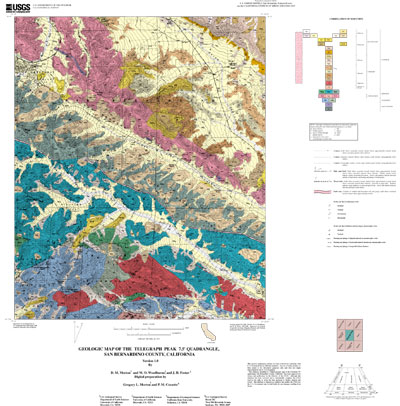
This data set maps and describes the geology of the Telegraph 7.5' quadrangle, San Bernardino
County, California. Created using Environmental Systems Research Institute's ARC/INFO
software, the data base consists of the following items: (1) a double precision map coverage
containing geologic contacts and units, (2) a coverage containing site-specific structural
data, (3) a coverage containing geologic-unit label leaders and their associated attribute
tables for geologic units (polygons), contacts (arcs), and site-specific data (points). In
addition, the data set includes the following graphic and text products: (1) A PostScript
graphic plot-file containing the geologic map, topography, cultural data, a Correlation of
Map Units (CMU) diagram, a Description of Map Units (DMU), an index map, a regional geologic
and structure map, and a key for point and line symbols; (2) PDF files of this Readme
(including the metadata file as an appendix), Description of Map Units (DMU), and the graphic
produced by the PostScript plot file.
The Telegraph Peak quadrangle is located in the eastern San Gabriel Mountains part of the
Transverse Ranges Province of southern California. The generally east-striking structural
grain characteristic of the crystalline rocks of much of the San Gabriel Mountains is
apparent, but not well developed in the Telegraph Peak quadrangle. Here, the east-striking
structural grain is somewhat masked by the northwest-striking grain associated with the San
Andreas Fault zone.
Faults within the quadrangle include northwest-striking, right-lateral strike-slip faults of
the San Andreas system. The active San Andreas Fault, located in the northern part of the
quadrangle, dominates the younger structural elements. North of the San Andreas Fault is the
inactive Cajon Valley Fault that was probably an early strand of the San Andreas system. It
was active during deposition of the middle Miocene Cajon Valley Formation. South of the San
Andreas, the Punchbowl Fault, which is probably a long-abandoned segment of the San Andreas
Fault (Matti and Morton, 1993), has a sinuous trace apparently due to compression in the
eastern San Gabriel Mountains that post-dates displacement on the fault. The Punchbowl Fault
separates two major subdivisions of the Mesozoic Pelona Schist and is left-laterally offset by
a northeast-striking fault in the northwestern part of the quadrangle. Within the Punchbowl
Fault zone is a thin layer of highly deformed basement rock, which is clearly not part of the
Pelona Schist. To the southeast, in the Devore quadrangle, this included basement rock
attains a thickness of several hundred feet. Along strike to the northwest, Tertiary
sedimentary rocks are included within the fault zone. South of the Punchbowl Fault are
several arcuate (in plan) faults that are part of an antiformal schuppen-like fault complex of
the eastern San Gabriel Mountains. Most of these arcuate faults are reactivated and deformed
older faults, and probably include the eastern part of the San Gabriel Fault.
The Vincent Thrust of late Cretaceous or early Tertiary age separates the Pelona Schist in the
lower plate from a heterogeneous basement complex in the upper plate. Immediately above the
Vincent Thrust is a variable thickness of mylonitic rock generally interpreted as a product
of displacement on the thrust. The upper plate includes two Paleozoic units, a schist and
gneiss sequence and a schist, quartzite, and marble metasedimentary sequence. Both sequences
are thrust over the Mesozoic Pelona Schist along the Vincent Thrust, and intruded by Tertiary
(late Oligocene) granitic rocks, granodiorite of Telegraph Peak, that also intrude the Vincent
Thrust. The Pelona Schist consists mostly of greenschist to amphibolite metamorphic grade
meta-basalt (greenschist and amphibolite) and meta-graywacke (siliceous and white mica
schist), with minor impure quartzite and marble, in which all primary structures have been
destroyed and all layering transposed. Cretaceous granitic rocks, chiefly tonalite, intrude
the schist and gneiss sequence, but not the Pelona Schist or the Vincent Thrust.
North of the San Andreas Fault, bedrock units consist of undifferentiated Cretaceous tonalite,
here informally named tonalite of Circle Mountain, with some included small boldies of gneiss
and marble. These basement rocks are the westward continuation of rocks of the San Bernardino
Mountains and not rocks of the San Gabriel Mountains south of the San Andreas Fault. Also
north of the San Andreas Fault are the Oligocene Vaqueros Formation, middle Miocene Cajon
Valley Formation, and Pliocene rocks of Phelan Peak. The latter two formations are divided
into several conglomerate and arkosic sandstone subunits. In the northeastern corner of the
quadrangle, the rocks of Phelan Peak are unconformably overlain by the Quaternary Harold
Formation and Shoemaker Gravel. Quaternary units ranging from early Pleistocene to recent are
mapped, and represent alluvial fan, landslide, talus, and wash environments.
The geologic map database contains original U.S. Geological Survey data generated by detailed
field observation and by interpretation of aerial photographs. This digital Open-File map
supercedes an older analog Open-File map of the quadrangle, and includes extensive new data on
the Quaternary deposits, and revises some fault and bedrock distribution within the San
Gabriel Mountains. The digital map was compiled on a base-stable cronoflex copy of the
Telegraph 7.5' topographic base and then scribed. This scribe guide was used to make a 0.007
mil blackline clear-film, from which lines and point were hand digitized. Lines, points, and
polygons were subsequently edited at the USGS using standard ARC/INFO commands. Digitizing
and editing artifacts significant enough to display at a scale of 1:24,000 were corrected.
Within the database, geologic contacts are represented as lines (arcs), geologic units as
polygons, and site-specific data as points. Polygon, arc, and point attribute tables (.pat,
.aat, and .pat, respectively) uniquely identify each geologic datum.
Purpose:
The data set for the Telegraph 7.5' quadrangle was prepared under the U.S. Geological Survey
Southern California Areal Mapping Project (SCAMP) and the California Division of Mines as part
of an ongoing effort to develop a regional geologic framework of southern California, and to
utilize a Geographical Information System (GIS) format to create regional digital geologic
databases. These regional databases are being developed as contributions to the National
Geologic Map Database of the National Cooperative Geologic Mapping Program of the USGS.
The digital geologic map database for the Telegraph 7.5' quadrangle has been created as a
general-purpose data set that is applicable to other land-related investigations in the earth
and biological sciences. For example, the U.S. Forest Service, San Bernardino National Forest,
may use the map and database as a basic geologic data source for soil studies, mineral resource
evaluations, road building, biological surveys, and general forest management. The database is
not suitable for site-specific geologic evaluations at scales greater than 1:24,000 (1 in =
2,000 ft).
Time_Period_of_Content:
Time_Period_Information:
Range_of_Dates/Times:
Beginning_Date: 19740401
Ending_Date: 19810801
Currentness_Reference: New data and previously published data
Status:
Progress: Complete
Maintenance_and_Update_Frequency: As needed
Spatial_Domain:
Bounding_Coordinates:
West_Bounding_Coordinate: -117.6250927
East_Bounding_Coordinate: -117.4999073
North_Bounding_Coordinate: 34.37499995
South_Bounding_Coordinate: 34.24998407
Keywords:
Theme:
Theme_Keyword_Thesaurus: none
Theme_Keyword: geologic map
Theme_Keyword: geology
Theme_Keyword: bedrock geology
Theme_Keyword: surficial geology
Theme_Keyword: San Andreas Fault
Theme_Keyword: San Jacinto Fault
Theme_Keyword: San Gabriel Mountains
Theme_Keyword: Pelona Schist
Theme:
Theme_Keyword_Thesaurus: ISO 19115 Topic Categories
Theme_Keyword: geoscientificInformation
Place:
Place_Keyword_Thesaurus: None
Place_Keyword: California
Place_Keyword: San Bernardino County
Place_Keyword: Telegraph 7.5' quadrangle
Place:
Place_Keyword_Thesaurus: Augmented FIPS 10-4 and FIPS 6-4, version 1.0
Place_Keyword: 06071 = San Bernardino
Access_Constraints: None
Use_Constraints:
The Telegraph 7.5' geologic-map database should be used to evaluate and understand the geologic
character of the Telegraph 7.5' quadrangle as a whole. The data should not be used for purposes
of site-specific land-use planning or site-specific geologic evaluations. The database is
sufficiently detailed to identify and characterize geologic materials and structures. However,
it is not sufficiently detailed for site-specific determinations.
Use of this digital geologic map database should not violate the spatial resolution of the data.
Although the digital form of the data removes the constraint imposed by the scale of a paper
map, the detail and accuracy inherent in map scale are also present in the digital data. The
fact that this database was compiled and edited at a scale of 1:24,000 means that higher
resolution information may not have been uniformly retained in the dataset. Plotting at scales
larger than 1:24,000 will not yield greater real detail, although it may reveal fine-scale
irregularities below the intended resolution of the database. Similarly, although higher
resolution data is incorporated in parts of the map, the resolution of the combined output will
be limited by the lower resolution data.
Point_of_Contact:
Contact_Information:
Contact_Person_Primary:
Contact_Person: Douglas M. Morton
Contact_Organization:
U.S. Geological Survey, Western Region, Earth Surface Processes Team
Contact_Position: Project geologist
Contact_Address:
Address_Type: mailing address
Address:
U.S. Geological Survey
Department of Earth Science
University of California, Riverside
Non-navigable image of the geologic map, topographic base, Correlation of Map Units,
Description of Map Units and key to point and line symbols. 400x406 pixels, 32-bit RGB true color, 54k bytes.
Navigable portable document file image of the geologic map, topographic base, Correlation
of Map Units, Description of Map Units and key to point and line symbols.
Browse_Graphic_File_Type: PDF
Data_Set_Credit:
Technical review by Michael Kennedy led to significant improvements that eventually were
reflected in aspects of the database, the plot file, and in the description of the geologic
units of the Telegraph 7.5' quadrangle.
Geologic mapping and digital preparation of this report were sponsored jointly by (1) the
National Cooperative Geologic Mapping Program of the U.S. Geological Survey, (2) the California
Division of Mines and Geology, and (3) the Southern California Areal Mapping Project (SCAMP).
In our digital preparation of the data set, carried out in the SCAMP Geographic Information
System laboratory at the University of California, Riverside by Gregory Morton, and in the USGS
Geographic Information System laboratory of the Mineral Resources Program of the U.S.
Geological Survey in Spokane, Washington by Pamela M. Cossette, we received valuable assistance
from Rachel Alvarez in Riverside, California, and from Paul C. Hyndman in Spokane, Washington.
Native_Data_Set_Environment:
SunOS, 5.7, sun4u UNIX
ARC/INFO version 7.2.1
Cross_Reference:
Citation_Information:
Originator: D.M. Morton
Publication_Date: 1976
Title:
Geologic map of the Cucamonga fault zone between San Antonio Canyon and Cajon Creek, southern
California
Edition: Version 1.0
Geospatial_Data_Presentation_Form: paper map
Series_Information:
Series_Name: U.S. Geological Survey Open-File Report
Issue_Identification: 76-726
Publication_Information:
Publication_Place: Menlo Park, California
Publisher: U.S. Geological Survey

Data_Quality_Information:
Attribute_Accuracy:
Attribute_Accuracy_Report:
Geologic-map units in the Telegraph quadrangle database were described using standard field
methods. Consistent with these methods, the database author has assigned standard geologic
attributes to geologic lines, points, and polygons identified in the database.
Nation-wide geologic-map accuracy standards have not been developed and adopted by the U.S.
Geological Survey and other earth-science entities. Until such standards are adopted, the SCAMP
project has developed internal map-accuracy standards for 1:24,000-scale geologic maps produced
by the project.
Geologic lines and points on 1:24,000 scale geologic maps are judged to meet SCAMP's internal
map-accuracy standards if they are located to within +/-15 meters, relative to topographic or
cultural features on the base map.
Lines and points that meet (or may not meet) this SCAMP internal map-accuracy standard are
identified both in the digital database and on derivative geologic-map plots. Within the
database, line and point data that are judged to meet the SCAMP internal map-accuracy standard
are denoted by the attribute code .MEE. (meets) in the appropriate data table; line and point
data that may not meet the SCAMP internal map-accuracy standard are denoted by the attribute
code .MNM. (may not meet).
On any derivative geologic-map plot, line data that are judged to meet the SCAMP internal
map-accuracy standard are denoted by solid lines; line data that may not meet the SCAMP internal
map-accuracy standard are denoted by dashed or dotted lines. There is no cartographic device
for denoting the map-accuracy for geologic-point data (eg. symbols representing bedding,
foliation, lineations, etc.).
Logical_Consistency_Report:
Polygon and chain-node topology present.
The areal extent of the map is represented digitally by an appropriately projected (Polyconic
projection), mathematically generated box. Consequently, polygons intersecting the lines that
comprise the map boundary are closed by that boundary. Polygons internal to the map boundary
are completely enclosed by line segments which are themselves a set of sequentially numbered
coordinate pairs. Point data are represented by coordinate pairs.
Completeness_Report:
The geologic map and digital database of the Telegraph 7.5' quadrangle contain new data that
have been subjected to rigorous review and are a substantially complete representation of the
current state of knowledge concerning the geology of the quadrangle.
Positional_Accuracy:
Horizontal_Positional_Accuracy:
Horizontal_Positional_Accuracy_Report:
The maximum transformation RMS error acceptable for 7.5' quadrangle transformation and data
input is 0.003 (7.6 meters). Horizontal positional accuracy was checked by visual comparison of
hard-copy plots with base-stable source data.
Lineage:
Process_Step:
Process_Description:
Field mapping and aerial photograph interpretation; iterative process (D.M. Morton).
Process_Date: 1977 to 1978 and 1988 to 1989
Process_Step:
Process_Description:
Aerial photograph interpretation and limited field checking; iterative process (D.M. Morton).
Process_Date: 1989
Process_Step:
Process_Description:
Transfer of geologic linework and point data from field maps and aerial photographs to a
scale-stable cartographic base of quadrangle (scribeguide) (D.M. Morton).
Process_Date: 1978 and 1989
Process_Step:
Process_Description:
Description of Map Units and Correlation of Map Units (D.M. Morton).
Process_Date: 1997
Process_Step:
Process_Description:
The geologic map information was hand digitized from a clear-film, right-reading, 0.007 mil
thickness, base-stable blackline positive (made by contact photograph from a scribeguide) of the
authors-prepared geologic map at 1:24,000 scale (G. Morton).
Process_Date: 1997
Process_Step:
Process_Description:
ARC/INFO database established; cleanup of digitizing artifacts; polygon, arc, and point
attribute tables established using model developed for SCAMP coverages. Digitizing and editing
artifacts significant enough to display at a scale of 1:24,000 were corrected (P.M. Cossette).
Process_Date: 1997, 1998 and 2001
Process_Step:
Process_Description:
First draft of metadata created by Cossette using FGDCMETA.AML ver. 1.2 05/14/98 on ARC/INFO
data set /pool5/c/cossette2/telegraph/tel_geo420a
Process_Date: 20010420
Spatial_Data_Organization_Information:
Direct_Spatial_Reference_Method: Vector
Point_and_Vector_Object_Information:
SDTS_Terms_Description:
SDTS_Point_and_Vector_Object_Type: Point
Point_and_Vector_Object_Count: 720
SDTS_Terms_Description:
SDTS_Point_and_Vector_Object_Type: String
Point_and_Vector_Object_Count: 1940
SDTS_Terms_Description:
SDTS_Point_and_Vector_Object_Type: GT-polygon composed of chains
Horizontal_Datum_Name: North American Datum of 1927
Ellipsoid_Name: Clarke 1866
Semi-major_Axis: 6378206.4
Denominator_of_Flattening_Ratio: 294.98
Entity_and_Attribute_Information:
Overview_Description:
Entity_and_Attribute_Overview:
Version 1.0 of the Telegraph 7.5' quadrangle comprises three ARC/INFO coverages, of which
two contain geologic data, and one contains cartographic features: tel_geo (geology),
tel_str (structural point data), and tel_ldr (annotation leaders). Two INFO tables,
lines.rel and points.rel provide a full description of each of the geologic line and point
features in the database. A full source citation is provided in the Entity_and
Attribute_Detail_Citation section of this metadata document.
Geologic data represented by line entities and the polygons they delineate are contained in the
coverage TEL_GEO. For display purposes, the geology coverage contains two annotation
subclasses: anno.geo contains unit labels, and anno.fault contains formal, fault names.
Geological point data includes site-specific information describing the types and the
orientation of bedding, foliation, and lineations. One annotation subclass is included in the
geologic points coverage, TEL_STR which displays displays the respective dip and plunge values
associated with individual point data.
Entity_and_Attribute_Detail_Citation:
A complete description of the polygon, line, and point data coding schemes is available in U.S.
Geological Survey Open-File Reports OFR 97-859, OFR 97-860, and OFR 97-861 (full source
citations follow):
Matti, J.C., Miller, F.K., Powell, R.E., Kennedy, S.A., Bunyapanasarn, T.P., Koukladas,
Catherine, Hauser, R.M., and Cossette, P.M., 1997b, Geologic-point attributes for digital
geologic-map databases produced by the Southern California Areal Mapping Project (SCAMP),
Version 1.0: U.S.Geological Survey Open-File Report 97-859
Matti, J.C., Miller, F.K., Powell, R.E., Kennedy, S.A., and Cossette, P.M., 1997c,
Geologic-polygon attributes for digital geologic-map databases produced by the Southern
California Areal Mapping Project (SCAMP), Version 1.0: U.S.Geological Survey Open-File Report
97-860
Matti, J.C., Powell, R.E., Miller, F.K., Kennedy, S.A., Ruppert, K.R., Morton, G.L., and
Cossette, P.M., 1997a, Geologic-line attributes for digital geologic-map databases produced by
the Southern California Areal Mapping Project (SCAMP), Version 1.0: U.S.Geological Survey
Open-File Report 97-861
Detailed_Description:
Entity_Type:
Entity_Type_Label: tel_geo.pat
Entity_Type_Definition:
Geologic units (LABL) and their corresponding names (NAME) identified in the Telegraph
7.5'quadrangle
Attribute:
Attribute_Label: LABL
Attribute_Definition: geologic map unit label, in plain text
Attribute_Domain_Values:
Enumerated_Domain:
Enumerated_Domain_Value: Kcm
Enumerated_Domain_Value_Definition: Tonalite of Circle Mountain
Attribute_Domain_Values:
Enumerated_Domain:
Enumerated_Domain_Value: Kgd
Enumerated_Domain_Value_Definition: Ganodiorite
Attribute_Domain_Values:
Enumerated_Domain:
Enumerated_Domain_Value: Kss
Enumerated_Domain_Value_Definition: Tonalite of San Sevaine Lookout
Enumerated_Domain_Value_Definition: Crushed rock in fault zones
Attribute_Domain_Values:
Enumerated_Domain:
Enumerated_Domain_Value: gn
Enumerated_Domain_Value_Definition: Gneiss
Attribute_Domain_Values:
Enumerated_Domain:
Enumerated_Domain_Value: m
Enumerated_Domain_Value_Definition: Marble
Attribute:
Attribute_Label: PLABL
Attribute_Definition:
Coded geologic map unit label used to generate plot labels with relevant stratigraphic symbols.
The geologic units with LABL designating Mesozoic (Mz), and Paleozoic (Pz), have keystroke
substitute characters, } and | respectively, that call their corresponding symbols from the
Geoage Font Group. Geologic map unit labels will plot on derivative map plots with appropriate
stratigraphic symbols if PLABL is used as the source for unit labels. The Geoage Font Group is
accessed through geofont.txt. The GeoAge Font Group and relevant information are available by
anonymous FTP from:
Server: onyx.wr.usgs.gov
Attribute:
Attribute_Label: SHDPS
Attribute_Definition:
polygon color (as integer value) from shadeset scamp2.shd (included in the data package)
Attribute:
Attribute_Label: SHDFIL
Attribute_Definition:
polygon fill pattern (as integer value) from shadeset geology2.shd
Attribute:
Attribute_Label: NAME
Attribute_Definition: Geologic name of map unit (see list under LABL attribute)
Detailed_Description:
Entity_Type:
Entity_Type_Label: tel_geo.aat
Entity_Type_Definition:
Geologic features such as contacts and faults that bound rock-unit polygons (a complete
description of each line type is available in the data table, lines.rel.)
Attribute:
Attribute_Label: L-TAG
Attribute_Definition:
Coded alpha-numerical symbol that relates arc to definition of line type in dictionary look-up
table (lines.rel). For description of attributes in line classification dictionary, refer to
USGS Open-File Report 97-861 (see Entity_and_Attribute_Detail_Citation)
Attribute_Domain_Values:
Enumerated_Domain:
Enumerated_Domain_Value: C1
Enumerated_Domain_Value_Definition: Contact, generic, certain, location meets map accuracy standard
Attribute_Domain_Values:
Enumerated_Domain:
Enumerated_Domain_Value: C17
Enumerated_Domain_Value_Definition:
Contact, landslide, certain, location meets map accuracy standard
Attribute_Domain_Values:
Enumerated_Domain:
Enumerated_Domain_Value: C18
Enumerated_Domain_Value_Definition:
Contact, landslide, certain, location may not meet map accuracy standard
Attribute_Domain_Values:
Enumerated_Domain:
Enumerated_Domain_Value: C19
Enumerated_Domain_Value_Definition:
Contact, landslide, inferred, location may not meet map accuracy standard
Attribute_Domain_Values:
Enumerated_Domain:
Enumerated_Domain_Value: C25
Enumerated_Domain_Value_Definition:
Contact, landslide, crown scarp, certain, location meets map accuracy standard
Attribute_Domain_Values:
Enumerated_Domain:
Enumerated_Domain_Value: C29
Enumerated_Domain_Value_Definition:
Contact, sedimentary, certain, location meets map accuracy standard
Attribute_Domain_Values:
Enumerated_Domain:
Enumerated_Domain_Value: C30
Enumerated_Domain_Value_Definition:
Contact, sedimentary, certain, location may not meet map accuracy standard
Attribute_Domain_Values:
Enumerated_Domain:
Enumerated_Domain_Value: C31
Enumerated_Domain_Value_Definition:
Contact, sedimentary, inferred, location may not meet map accuracy standard
Attribute_Domain_Values:
Enumerated_Domain:
Enumerated_Domain_Value: C50
Enumerated_Domain_Value_Definition: Contact, igneous, location may not meet map accuracy standard
Attribute_Domain_Values:
Enumerated_Domain:
Enumerated_Domain_Value: C51
Enumerated_Domain_Value_Definition:
Contact, igneous, inferred, location may not meet map accuracy standard
Attribute_Domain_Values:
Enumerated_Domain:
Enumerated_Domain_Value: C66
Enumerated_Domain_Value_Definition:
Contact, metamorphic, certain, location may not meet map accuracy standard
Attribute_Domain_Values:
Enumerated_Domain:
Enumerated_Domain_Value: C67
Enumerated_Domain_Value_Definition:
Contact, metamorphic, inferred, location may not meet map accuracy standard
Fault, high angle, slip unspecified, location meets map accuracy standard
Attribute_Domain_Values:
Enumerated_Domain:
Enumerated_Domain_Value: F15
Enumerated_Domain_Value_Definition:
Fault, high angle, strike slip, left lateral, inferred, location may not meet map accuracy
standard
Attribute_Domain_Values:
Enumerated_Domain:
Enumerated_Domain_Value: F177
Enumerated_Domain_Value_Definition:
Fault, thrust, older over younger, certain, location meets map accuracy standard
Attribute_Domain_Values:
Enumerated_Domain:
Enumerated_Domain_Value: F180
Enumerated_Domain_Value_Definition:
Fault, thrust, older over younger, concealed, location may not meet map accuracy standard
Attribute_Domain_Values:
Enumerated_Domain:
Enumerated_Domain_Value: F19
Enumerated_Domain_Value_Definition:
Fault, high angle, slip unspecified, concealed, location may not meet map accuracy standard
Attribute_Domain_Values:
Enumerated_Domain:
Enumerated_Domain_Value: F2
Enumerated_Domain_Value_Definition:
Fault, high angle, right lateral strike slip, certain, location meets map accuracy standard
Attribute_Domain_Values:
Enumerated_Domain:
Enumerated_Domain_Value: F20
Enumerated_Domain_Value_Definition:
Fault, high angle, right lateral strike slip, concealed, location may not meet map accuracy
standard
Attribute_Domain_Values:
Enumerated_Domain:
Enumerated_Domain_Value: F21
Enumerated_Domain_Value_Definition:
Fault, high angle, strike slip, left lateral, inferred, location may not meet map accuracy
standard
Attribute_Domain_Values:
Enumerated_Domain:
Enumerated_Domain_Value: F24
Enumerated_Domain_Value_Definition:
Fault, high angle, oblique slip, inferred, location may not meet map accuracy standard
Attribute_Domain_Values:
Enumerated_Domain:
Enumerated_Domain_Value: F3
Enumerated_Domain_Value_Definition:
Fault, high angle, left lateral strike slip, scarp, certain, location meets map accuracy
standard
Attribute_Domain_Values:
Enumerated_Domain:
Enumerated_Domain_Value: F45
Enumerated_Domain_Value_Definition:
Fault, high angle, left lateral strike slip, questionable, inferred, location may not meet map
accuracy standard
Attribute_Domain_Values:
Enumerated_Domain:
Enumerated_Domain_Value: F6
Enumerated_Domain_Value_Definition:
Fault, high angle, oblique slip, certain, location meets map accuracy standard
Attribute:
Attribute_Label: L-SYMB
Attribute_Definition:
stores appropriate line symbol value from the lineset geoscamp2.lin
Attribute:
Attribute_Label: L-NAME
Attribute_Definition: Formal name of fault
Detailed_Description:
Entity_Type:
Entity_Type_Label: tel_str.pat
Entity_Type_Definition:
Geological point data includes site-specific information describing the types and the
orientation of bedding, foliation, and lineations. One annotation subclass is included in the
geologic points coverage, TEL_STR and displays the respective dip and plunge values associated
with individual point data.
Attribute:
Attribute_Label: P-TAG
Attribute_Definition:
Coded alpha-numerical value that relates point entity to definition of point type in dictionary
INFO table, points.rel. For description of attributes in point classification dictionary, refer
to USGS Open-File Report 97-859 (see Entity_and_Attribute_Detail_Citation)
Enumerated_Domain_Value_Definition: Lineation, metamorphic, aligned mineral grains
Attribute:
Attribute_Label: P-SYMB
Attribute_Definition:
Coded integer value that relates point to cartographic point symbol in markerset geoscamp2.mrk
Attribute:
Attribute_Label: P-DIP
Attribute_Definition: Dip of planar feature
Attribute:
Attribute_Label: P-STRIKE
Attribute_Definition: Azimuthal strike of planar feature
Attribute:
Attribute_Label: P-DIPDIR
Attribute_Definition: Azimuthal direction of dip of planar feature
Attribute:
Attribute_Label: P-PLUNGE
Attribute_Definition: Plunge of linear feature
Attribute:
Attribute_Label: P-BEARING
Attribute_Definition: Azimuthal direction of plunge of linear feature
Detailed_Description:
Entity_Type:
Entity_Type_Label: tel_ldr.aat
Entity_Type_Definition: Annotation leaders
Attribute:
Attribute_Label: L-SYMB
Attribute_Definition:
Coded integer value (1) that relates arcs to cartographic line symbol in lineset
Distribution_Information:
Distributor:
Contact_Information:
Contact_Organization_Primary:
Contact_Organization: U.S. Geological Survey Information Services
Contact_Address:
Address_Type: mailing address
Address: Box 25286 Denver Federal Center
City: Denver
State_or_Province: CO
Postal_Code: 80225
Country: USA
Contact_Voice_Telephone: 303-202-4700
Contact_Facsimile_Telephone: 303-202-4693
Distribution_Liability:
The U.S. Geological Survey (USGS) provides these geographic data "as is." The USGS makes no
guarantee or warranty concerning the accuracy of information contained in the geographic data.
The USGS further makes no warranties, either expressed or implied as to any other matter
whatsoever, including, without limitation, the condition of the product, or its fitness for any
particular purpose. The burden for determining fitness for use lies entirely with the user.
Although these data have been processed successfully on computers at the USGS, no warranty,
expressed or implied, is made by the USGS regarding the use of these data on any other system,
nor does the fact of distribution constitute or imply any such warranty.
In no event shall the USGS have any liability whatsoever for payment of any consequential,
incidental, indirect, special, or tort damages of any kind, including, but not limited to, any
loss of profits arising out of use of or reliance on the geographic data or arising out of the
delivery, installation, operation, or support by USGS.
This digital, geologic map database of the Telegraph Peak 7.5' quadrangle, 1:24,000 map-scale,
and any derivative maps thereof, is not meant to be used or displayed at any scale larger than
1:24,000 (e.g., 1:12,000).
Standard_Order_Process:
Digital_Form:
Digital_Transfer_Information:
Format_Name: ArcInfo export (e00)
Format_Version_Number: 7.2.1
Format_Information_Content:
Geologic units and structural features, along with
base topography as a black-and-white geotiff image.
Metadata_Standard_Name: Content Standard for Digital Geospatial Metadata
Metadata_Standard_Version: FGDC-STD-001-1998
Metadata_Access_Constraints: none
Metadata_Use_Constraints: none
This page is <http://geo-nsdi.er.usgs.gov/metadata/open-file/01-293/metadata.html> How other people discovered this page
Generated by mp version 2.9.10 on Tue Nov 3 15:22:41 2009