USGS Geoscience Data Catalog
Additional USGS Geoscience data can be found by geographic location or by publication series.
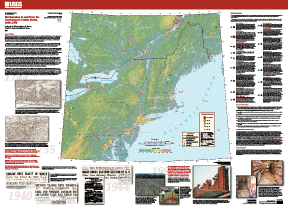
Wheeler, Russell L. , 2001, Digital spatial data for the map "Earthquakes in and near the northeastern United States, 1638-1998": U.S. Geological Survey Geologic Investigations Series I-2737.Online Links:
This is a Point data set. It contains the following vector data types (SDTS terminology):
Horizontal positions are specified in geographic coordinates, that is, latitude and longitude. Latitudes are given to the nearest 0.0001. Longitudes are given to the nearest 0.0001. Latitude and longitude values are specified in Decimal degrees.
The horizontal datum used is NAD 1927.
The ellipsoid used is Clarke 1866.
The semi-major axis of the ellipsoid used is 6,378,206.4.
The flattening of the ellipsoid used is 1/294.98.
| Range of values | |
|---|---|
| Minimum: | 1638 |
| Maximum: | 1998 |
| Units: | year |
| Resolution: | 1 |
| Range of values | |
|---|---|
| Minimum: | 01 |
| Maximum: | 12 |
| Units: | month |
| Resolution: | 1 |
| Range of values | |
|---|---|
| Minimum: | 01 |
| Maximum: | 31 |
| Units: | day |
| Resolution: | 1 |
| Range of values | |
|---|---|
| Minimum: | -81.000 |
| Maximum: | -66.100 |
| Units: | deg |
| Resolution: | 0.0001 |
| Range of values | |
|---|---|
| Minimum: | 38.000 |
| Maximum: | 47.998 |
| Units: | deg |
| Resolution: | 0.0001 |
| Range of values | |
|---|---|
| Minimum: | 3.0 |
| Maximum: | 7.0 |
| Units: | magnitude unit |
| Resolution: | 0.1 |
| Formal codeset | |
|---|---|
| Codeset Name: | Reference Codes |
| Codeset Source: | Reference code list is found in <http://greenwood.cr.usgs.gov/pub/i-maps/i-2737/catalog.txt> |
| Value | Definition |
|---|---|
| AT | 100-300 km (60-200 mi) offshore in Atlantic Ocean |
| CN | Canada |
| CT | Connecticut |
| DL | Delaware |
| MA | Massachusetts |
| MD | Maryland |
| ME | Maine |
| NH | New Hampshire |
| NJ | New Jersey |
| NY | New York |
| OH | Ohio |
| PA | Pennsylvania |
| RI | Rhode Island |
| VA | Virginia |
| VT | Vermont |
| WV | West Virginia |
The map and parts of the earthquake descriptions and catalog were improved by suggestions and data from John Adams, Shelton Alexander, John Armbruster, Stefanie Baxter, Martin Chapman, Edward Cranswick, Pamela Detra, James Dewey, Charles Doll, Daniel Dombroski, Jr., Janet Drysdale, John Ebel, Rodger Faill, Robert Fakundiny, Edward Fratto, Stephen Halchuk, Michael Hansen, Klaus Jacob, Alan Kafka, Won-Young Kim, John Lahr, Kathleen Langone, Charles Langston, Nancy McHone, Stuart Nishenko, Gary Nottis, James Reger, Charles Scharnberger, Leonardo Seeber, and Nafi Toksoz.
(303) 273-8589 (voice)
(303) 273-8600 (FAX)
wheeler@usgs.gov
The map is an educational tool with which to inform the public about the existence and the broad, regional nature of earthquake hazard in the Northeast. The data were created digitally in order to ease and speed production and publication of the map. Text on the map cautions against using the map for scientific or engineering purposes, or to estimate hazard in small areas or at single sites. Entries in Lineage under Data_Quality_Information explain the reasons for this caution (see also Wheeler, 2000; reference in Lineage).
The earthquake catalog was constructed in such a way that it should not be utilized in scientific, engineering, or hazards use ( Wheeler, 2000; reference in Lineage). Accordingly, the catalog is not being published separately, in order to minimize the potential for misuse. It is available only as part of the digital files from which the entire map was made.
Wheeler, Russell L. , 2000, Earthquakes of the northeastern United States and adjacent Canada, 1638-1998--Construction of the earthquake catalog for an outreach map: U.S. Geological Survey Open-File Report 00-0316, 6 p., U.S. Geological Survey, Denver, Colorado.Online Links:
Russell L. Wheeler, Nathan K. Trevor, Arthur C. Tarr, and Anthony J. Crone, 2001, Earthquakes of the northeastern United States and adjacent Canada, 1638-1998: U.S. Geological Survey Geologic Investigations Series I-2737, U.S. Geological Survey, Reston, Virginia.Online Links:
Person who carried out this activity:
(303) 273-8570 (voice)
(303) 273-8600 (FAX)
atarr@usgs.gov
Person who carried out this activity:
(303) 273-8570 (voice)
(303) 273-8600 (FAX)
atarr@usgs.gov
Person who carried out this activity:
(303) 273-8570 (voice)
(303) 273-8600 (FAX)
atarr@usgs.gov
Person who carried out this activity:
(303) 273-8570 (voice)
(303) 273-8600 (FAX)
atarr@usgs.gov
Person who carried out this activity:
(303) 273-8570 (voice)
(303) 273-8600 (FAX)
atarr@usgs.gov
Person who carried out this activity:
(303) 273-8570 (voice)
(303) 273-8600 (FAX)
atarr@usgs.gov
Person who carried out this activity:
(303) 273-8570 (voice)
(303) 273-8600 (FAX)
atarr@usgs.gov
Person who carried out this activity:
(303) 273-8570 (voice)
(303) 273-8600 (FAX)
atarr@usgs.gov
No formal tests were devised for attribute accuracy of the earthquake epicentral parameters and magnitudes (other than checking transfer of values to the input data file) because attribute accuracy was best ascertained by individual contributors to the master catalog. See also Horizontal_Positional_Accuracy_Report.
Accuracies of the earthquake locations vary with earthquake magnitude, date of occurrence, closeness to settled areas, and method used to calculate or estimate the location. Locations of modern earthquakes may be reported to the nearest 0.0001 degree and may be accurate to within several kilometers. Locations of earthquakes that predate the installation of seismographs may be known only to the nearest tenth or half a degree, or even to the nearest whole degree. All locations were taken from standard sources, and none were tested or modified.
No depth information was included in the source table.
Small or old earthquakes are more likely to have been missed than large or recent ones. Because limited resources required use of existing earthquake catalogs, the catalog compiled for the map may contain duplicates, omissions, and blasts or other nonseismic events. Text on the map explains these factors at greater length.
Logical consistency checks were conducted during preparation of the map by visual examination of the positions of plotted symbols on the base map (searching for spurious locations) and cross-checking the tabular locations and magnitudes of the largest earthquakes against their graphical representation.
Are there legal restrictions on access or use of the data?
- Access_Constraints: None
- Use_Constraints: None
303-236-5486 (voice)
USGS Geologic Investigations Series I-2737
This earthquake catalog was compiled for educational and display purposes only, and should not be used for scientific, engineering, or hazards purposes. Reasons are described in text on the map, and in Wheeler (2000; reference in Lineage). Although these digital spatial data have been subjected to rigorous review and are substantially complete, they are released on the condition that neither the USGS nor the United States Government may be held liable for any damages resulting from their authorized or unauthorized use.
| Data format: | Geographic features and attributes in format Arc/Info export and ArcView shapefile (version 7.2.1) |
|---|---|
| Network links: |
<http://greenwood.cr.usgs.gov/pub/i-maps/i-2737/> |
(888)-ASK-USGS (voice)
USGS Geologic Investigations Series I-2737
none
Available as one printed map sheet.
For current prices of USGS information products, please see <http://mapping.usgs.gov/esic/prices/>.
(303) 273-8589 (voice)
(303) 273-8600 (FAX)
wheeler@usgs.gov