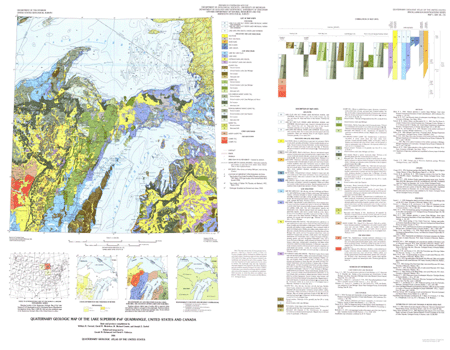
The dataset for the Lake Superior quadrangle consists of 10 coverages.
       geo_net
       gla_lin
       gla_pnt
       hydr_lin
       topo_lin
       bnd_lin
       bnd_net
       rd_lin
       rr_lin
       grid_lin
The dataset also includes an ARC/INFO AML, lineset, shadeset, and
markerset that will produce the EPS file of the geology and glacial
features and the list of map units.
Online Links:
GEOCODE        MAP_UNITS, (AGE)
lm       LAKE CLAY AND SILT UNDER LAKES MICHIGAN, HURON, AND
           SUPERIOR (HOLOCENE)
lc       LAKE SILT AND CLAY UNDER LAKES MICHIGAN, HURON, AND
           SUPERIOR (HOLOCENE)
ls       LAKE SAND AND GRAVEL UNDER LAKE SUPERIOR (HOLOCENE)
al       ALLUVIUM (HOLOCENE AND LATE WISCONSIN)
hp       PEAT AND MUCK (HOLOCENE AND LATE WISCONSIN)
ed       DUNE SAND (HOLOCENE AND LATE WISCONSIN)
lds      DELTA SAND (HOLOCENE AND LATE WISCONSIN)
lga      LAKE GRAVEL (HOLOCENE AND LATE WISCONSIN)
lca      LAKE SILT AND CLAY (LATE WISCONSIN)
lsa      LAKE SAND (LATE WISCONSIN)
gg       OUTWASH SAND AND GRAVEL (LATE WISCONSIN)
kg       ICE-CONTACT SAND AND GRAVEL (LATE WISCONSIN)
tc       CLAYEY TILL, Ground moraine (LATE WISCONSIN)
tc       CLAYEY TILL, Ground moraine under Lake Michigan
           (LATE WISCONSIN)
tc       CLAYEY TILL, End moraine (LATE WISCONSIN)
tcr      CLAYEY TILL, Attenuated drift (LATE WISCONSIN)
tl       LOAMY TILL, Ground moraine (LATE WISCONSIN)
tl       LOAMY TILL, Ground moraine under Lake Michigan
           (LATE WISCONSIN)
tl       LOAMY TILL, End moraine (LATE WISCONSIN)
tlr      LOAMY TILL, Attenuated drift (LATE WISCONSIN)
td       CALCAREOUS SANDY LOAMY TILL, Ground moraine
           (LATE WISCONSIN)
td       CALCAREOUS SANDY LOAMY TILL, Ground moraine under
           Lakes Michigan and Huron (LATE WISCONSIN)
td       CALCAREOUS SANDY LOAMY TILL, End moraine (LATE WISCONSIN)
tdr      CALCAREOUS SANDY LOAMY TILL, Attenuated drift
           (LATE WISCONSIN)
tdb      NONCALCAREOUS SANDY LOAMY TILL, Ground moraine (LATE
           WISCONSIN)
tdb      NONCALCAREOUS SANDY LOAMY TILL, Ground moraine under Lake
           Superior (LATE WISCONSIN)
tdb      NONCALCAREOUS SANDY LOAMY TILL, End moraine (LATE WISCONSIN)
tdr      NONCALCAREOUS SANDY LOAMY TILL, Attenuated drift (LATE
           WISCONSIN)
ts       SANDY TILL, Ground moraine (LATE WISCONSIN)
tsr      SANDY TILL, Attenuated drift (LATE WISCONSIN)
tde      SANDY LOAMY TILL (EARLY WISCONSIN)
tlp      LOAMY TILL (PRE WISCONSIN)
tlq      LOAMY TILL (PRE WISCONSIN)
The geo_net.aat INFO file consists of the following items:
LTYPE--Refers to the type of arc and is one of the following:
"contact", "shoreline", "map boundary", or "null". Null is the
imaginary line separating streams from lakes.
ACCURACY--Refers to accuracy of location of arcs in the geo_net
coverage and is either "certain" or "inferred".
Quaternary Geologic Map of the Lake Superior 4° x 6° Quadrangle, United States and Canada, I-1420 (NL-16) was compiled by William R. Farrand, Department of Geological Sciences, University of Michigan; David M. Mickelson, Department of Geology and Geophysics, University of Wisconsin; W. Richard Cowan, Ontario Department of Natural Resources; and Joseph E. Goebel, Minnesota Geological Survey; the state and province compilations were edited and integrated by Gerald M. Richmond, and David S. Fullerton, U.S. Geological Survey. The compilations of geology and glacial features were converted to digital form by Techni Graphic Systems, Inc., of Fort Collins, CO, under contract with the U.S. Geological Survey and modified by Charles A. Bush. Illustrations, word processor files and DLG coverages were prepared by Charles A. Bush and Christy E. Briles, U.S. Geological Survey. Hydrography and topography coverages were scanned and vectorized by C.A. Bush and C.E. Briles.
In recent years, surficial deposits and materials have become the focus of much interest by scientists, environmentalists, governmental agencies, and the general public. They are the foundations of ecosystems, the materials that support plant growth and animal habitat, and the materials through which travels much of the water required for our agriculture, our industry, and our general well being. They also are materials that easily can become contaminated by pesticides, fertilizers, and toxic wastes. In this context, the value of the surficial geologic map is evident
The description of map units and sources of information are both included as text files.
Are there legal restrictions on access or use of the data?Access_Constraints: None
Use_Constraints:Acknowledgment of the Quaternary Geologic Atlas of the United States of America and (or) the U.S. Geological Survey in products derived from these data will be appreciated.
Any use of trade, product, or firm names is for descriptive purposes only and does not imply endorsement by the U.S. Government. Although this data set has been used by the U.S. Geological Survey, no warranty, expressed or implied, is made by the USGS as to the accuracy and functioning of the data set and related material nor shall the fact of distribution constitute any such warranty, and no responsibility is assumed by the USGS in connection therewith.
| Data format: | Geologic units, structural features, diagrams, and ancillary data in format ARCE, Shapefile (version 7.2.1) |
|---|---|
| Network links: |
http://pubs.usgs.gov/imap/i-1420/nl-16/lakesuperior.tar.gz |